Redesigned design-to-code pipeline: one designer, 30 seconds per token update

Bridging Design and Engineering

A palette update used to take three people and a full day. I got it down to one designer and 30 seconds.

At LexisNexis Risk Solutions, I inherited a design system where Figma, Storybook, and production code spoke different languages. Designers named colors one way. Engineers named them another. Every handoff was a manual translation — and every translation introduced drift.

Over seven months, I ran the user research that shaped the product roadmap, built the prototypes that validated it, and created the token infrastructure that connected design to code for the first time. The result was a pipeline now used by every designer and engineer on two product teams.

Dovetail research analysis showing tagged insights from fraud analyst interviews

Two design systems. Zero shared language.

LexisNexis Risk Solutions runs ThreatMetrix, a fraud detection platform used by financial institutions worldwide. When I joined, the design org maintained two separate Figma design systems — one for Risk Narrative, one for ThreatMetrix — with no connection between them or to the codebase.

Updating a color palette meant one designer rebuilding swatches in Figma, then two UX engineers manually translating those values into Storybook and production CSS. A single palette change consumed a full working day. Names didn't match across systems, so "primary-blue" in Figma might be "brand-action" in Storybook and something else entirely in the React components.

Meanwhile, fraud analysts — the people actually using the product — had never been formally interviewed about their workflows. The dashboards they relied on daily were rigid, one-size-fits-all layouts built on assumptions, not evidence. No one had asked them what they needed.

I saw three problems woven into one: a research gap, a prototyping gap, and an infrastructure gap. Fixing any one of them in isolation wouldn't hold. The solution had to connect all three.

Eight interviews that rewrote the roadmap.

Custom Layouts had been on the roadmap as a response to friction the analysts kept hitting in the existing fixed-dashboard workflow, but no one had yet done the research to ground what "custom" should actually mean. Engineering wasn't going to build a flexible layout system on assumptions. That's where I came in.

My job in research was to join client calls and dig into the recordings — looking for the moments analysts struggled with the existing dashboards, and the workarounds and feature requests they kept circling back to. I tagged everything in Dovetail across 8 interviews.

The core finding was stark. Analysts were monitoring fraud across dozens of signals simultaneously, but the dashboard forced them into a fixed layout that didn't match how any of them actually worked. One analyst described toggling between four browser tabs because a single view couldn't show what they needed side by side.

After two rounds of feedback from the PM, the report was tight enough to drive sprint planning. Custom layouts, template libraries, and movable widgets all trace back to insights from those interviews.

What the clean version leaves out: I was bad at this at first. Hours of recordings in Dovetail, and I couldn't tell the difference between what was actually insight and what was just conversation. My first draft of the insight report wandered, and the PM could tell. He gave me sharp direction, but the gap wasn't going to close on its own.

So I scheduled a call with the senior researcher who'd designed the Dovetail taxonomy. I asked her how she separated signal from noise. What I got back wasn't a methodology lecture — it was a set of specific habits. How to listen for the moment a user stops answering your question and starts telling you what's in their head. How to mercilessly cut quotes that are interesting but not actionable. How to write an insight specific enough that a PM could build a ticket from it.

By the third round of interviews I was tagging in real time during the sessions. The second draft of the report was a different document.

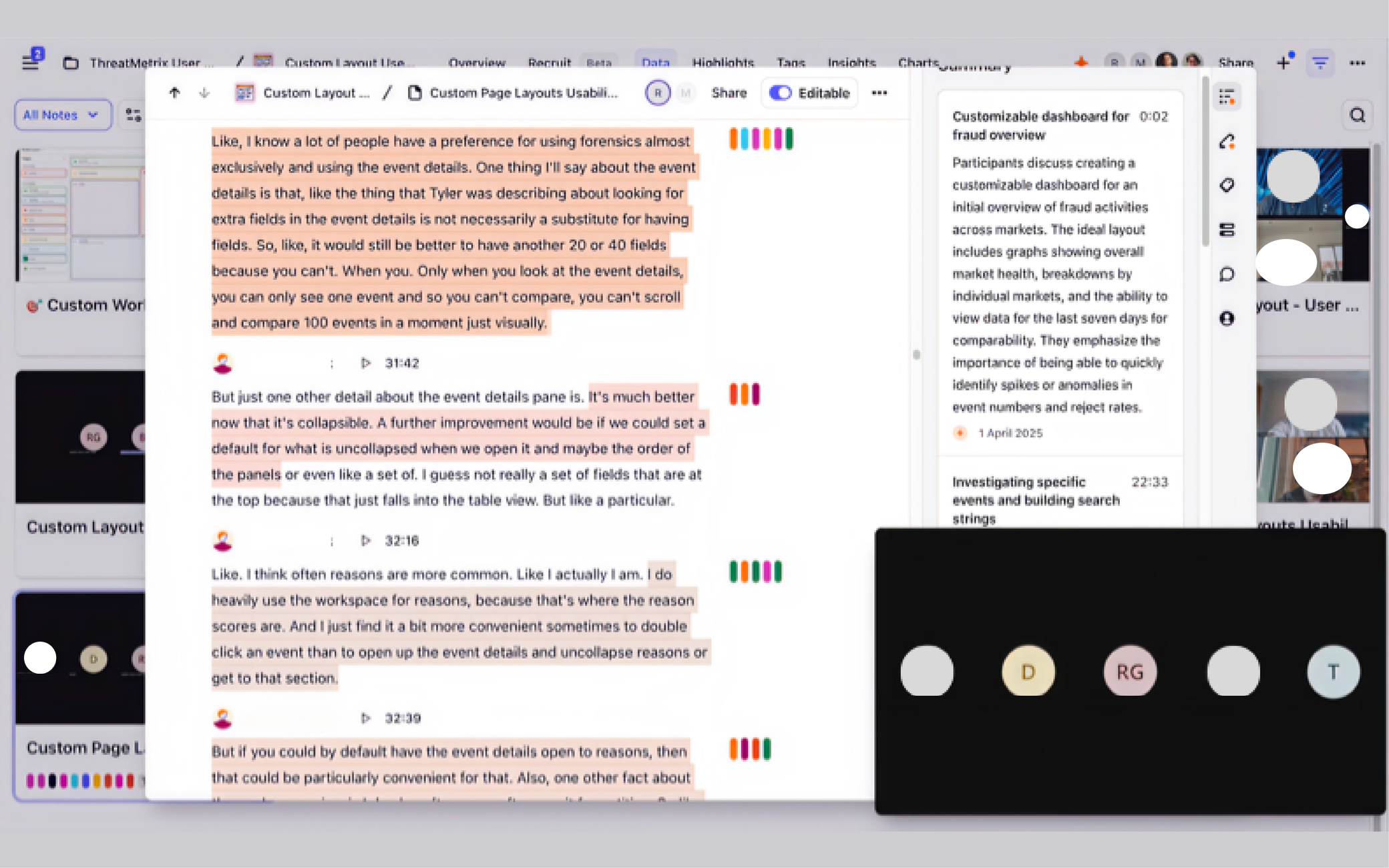
Dovetail usability study insight card with user quote from Custom Page Layouts research
Research tag taxonomy in Dovetail showing Persona, Migrated, and Product Area categories

Three rounds in two weeks. Each one driven by the people who'd use it.

With the research pointing clearly at customizable dashboards, I needed to validate the concept fast — without touching production. I built an interactive Figma prototype that simulated drag-and-drop layout customization, letting analysts rearrange widgets, resize panels, and test different configurations in a controlled environment.

I ran 3 rounds of moderated testing over 2 weeks. Each round, I watched analysts interact with the prototype, noted where they hesitated or got stuck, and shipped an updated version before the next session. By the third round, users were completing tasks without guidance.

The prototype pulled spacing rules and color tokens from the pipeline work already underway, so what analysts saw in testing matched what they'd eventually see in production. PMs used the prototype to gather stakeholder buy-in without engineering resources — it became a reusable testing tool the team continued using after I moved on.

Dashboard prototype — wide layout view
Dashboard prototype — component detail view
Dashboard prototype — scenario layout

One source of truth for two design systems.

I created a Figma token library with 180+ colors, each WCAG-tested for accessibility and assigned semantic aliases that described usage, not just appearance — so "surface-elevated" and "feedback-error" replaced ambiguous names like "gray-200" or "red-3."

I collaborated with a UX engineer to define the JSON export schema, making sure token names, nesting structure, and value formats would survive the trip from Figma to code without manual cleanup. We tested the export against Storybook components and iterated on the naming convention until there were zero mismatches.

The pipeline: Figma variables export as JSON design tokens, a parsing script converts them into CSS files and JS config objects, those feed into Storybook and from there into production React components. A change log keeps Figma and Storybook in bidirectional sync — serving both Risk Narrative and ThreatMetrix through a shared atomic structure.

What previously required one designer and two engineers coordinating over a full day now takes a single designer under 30 seconds. Update the token in Figma, export, and the change propagates everywhere.

Figma variables panel showing the 106-variable color token system with semantic aliases
Color palette reference showing 4 color categories with 11 steps each and hex values
Design system components using token pipeline

Infrastructure that outlasts the project.

Palette updates: full day → 30 seconds — a process that required 3 people now takes 1.

180+ WCAG-tested tokens serving 2 design systems through a single shared architecture.

8 user interviews that directly shaped the Custom Layouts product roadmap — template libraries, movable widgets, and flexible views all traced back to this research.

3 prototype iterations in 2 weeks that validated the direction before a single line of production code was written.

The token pipeline became the foundation for the 2025 design system rollout across LexisNexis Risk Solutions. The prototype became a reusable testing tool. The research report is still referenced in sprint planning.

The most impactful design work is often the work users never see. But every designer and engineer on both product teams now ships faster, more consistently, and with fewer handoff errors because this infrastructure exists.

Before and after comparison: 8-step pipeline requiring 3 people and a full day versus 3-step pipeline requiring 1 designer and 30 seconds

What I'd do differently: ask for help sooner. I spent too long trying to figure out the research process on my own before scheduling that call with the senior researcher. The quality of the work jumped the moment I stopped trying to look capable and started trying to get better. That's a lesson I've kept since — the fastest way to become good at something new is to find the person who's already good at it and ask them specific questions.

Other Work